Home › Enterprise Security › Zero Trust Architecture Explained: The Complete 2026 Enterprise Guide
Enterprise SecurityZero Trust Architecture Explained: The Complete 2026 Enterprise Guide
By Himanshu Borikar • 2026-07-28 • 18 min read
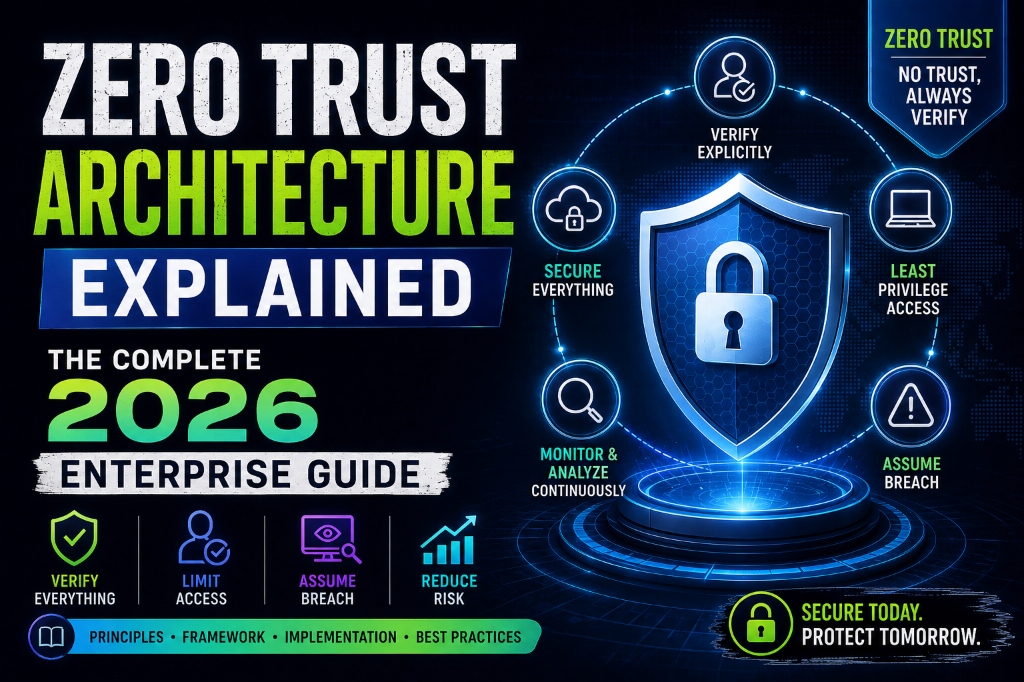
1. It Started With One Login
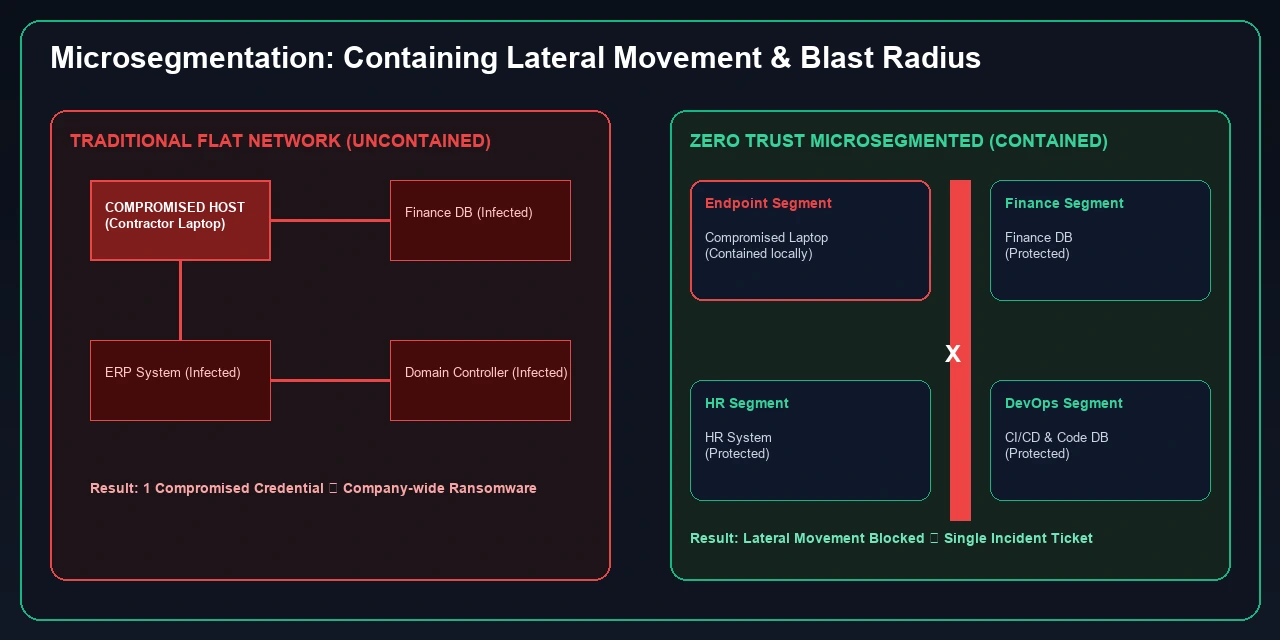
At 2:14 AM, a help desk contractor in another time zone typed in a password that worked on the first try. It belonged to a finance director who'd used it on three other sites. The VPN client accepted it without blinking - right network, right credentials, green light. From there, nothing stood in the way. The contractor's laptop, now a finance director's laptop as far as the network was concerned, could see the file shares, the ERP system, the domain controller. No second check. No "wait, is this really you." Just a flat, trusting network that had already decided this connection was safe the moment the VPN handshake succeeded.
Twenty-six hours later, backups were encrypted, and the incident response retainer got its first call of the quarter.
This is not a rare story. It is, with minor variations, the plot of most ransomware breaches that make the news. The technical root cause is rarely a zero-day. It's usually something duller and more dangerous: a network built on the assumption that once you're inside, you're trusted.
That assumption is exactly what Zero Trust Architecture exists to remove.
This guide is a full working reference - not a marketing overview - for what Zero Trust actually is, how it's built, how it fails when done wrong, and how security teams, cloud architects, and DevSecOps engineers implement it in real environments. We'll go from the origin of the term, through NIST's formal model, into ZTNA, microsegmentation, identity, cloud, Kubernetes, APIs, AI agents, and a full 12-month rollout roadmap - with diagrams, tables, checklists, and a case study drawn from real patterns we see across enterprise environments.
In short: Zero Trust replaces implicit network trust with continuous, contextual verification of every user, device, and workload - regardless of location.
2. What Is Zero Trust Architecture?
Zero Trust Architecture (ZTA) is a security model built on one operating principle: no user, device, or system is trusted by default, no matter where it sits - inside the corporate network or outside it. Every access request is verified, authorized, and continuously re-evaluated based on identity, device posture, and context, before it's granted the least privilege necessary to do the job.
Where the term came from
The phrase "Zero Trust" was popularized by Forrester analyst John Kindervag around 2010, who argued that network location should never imply trust. Google's internal BeyondCorp initiative, launched after the 2009 Operation Aurora attacks, put this into practice at scale - eliminating the corporate VPN entirely in favor of per-request authentication and device checks. Gartner later folded these ideas into its CARTA (Continuous Adaptive Risk and Trust Assessment) and SASE frameworks, pushing Zero Trust from a niche network philosophy into a mainstream enterprise architecture pattern.
The NIST definition
The most widely cited formal definition comes from NIST SP 800-207, which describes Zero Trust as a set of concepts designed to minimize uncertainty in enforcing accurate, least-privilege, per-request access decisions in information systems, treating every resource as if it's reachable from an open, untrusted network. NIST doesn't prescribe a single product or architecture - it defines tenets, which is why Zero Trust is best understood as a strategy, not a product category.
Modern enterprise adoption
By 2026, Zero Trust has moved from "innovative pilot" to baseline expectation in regulated industries - driven by U.S. federal mandates (OMB M-22-09), CISA's Zero Trust Maturity Model, EU NIS2 requirements, and cyber-insurance underwriters who now ask about it directly on renewal questionnaires. It's no longer a differentiator; it's table stakes.
3. Why Traditional Security Fails
The castle-and-moat problem
Traditional network security models the enterprise as a castle: a strong perimeter (the moat - firewalls, VPNs) keeps attackers out, and everything inside the walls is trusted. This worked reasonably well when applications lived in a single data center and employees worked from a single office. It fails completely once you have SaaS applications, remote employees, contractor laptops, mobile devices, and multi-cloud workloads - because there is no longer a single, definable perimeter to defend.
graph LR
    subgraph "Castle-and-Moat Model"
    A[Internet] -->|Firewall| B[Trusted Internal Network]
    B --> C[App Server]
    B --> D[File Share]
    B --> E[Database]
    B -.implicit trust.-> C
    B -.implicit trust.-> D
    B -.implicit trust.-> E
    end
Once an attacker - or a stolen credential - gets past the moat, they inherit the castle's implicit trust. That's how a single compromised laptop becomes a domain-wide breach.
Specific failure modes
- VPN trust problems: A VPN authenticates the connection, not the request. Once tunneled in, a device typically has broad network-layer access, which is exactly what attackers exploit for lateral movement.
- Insider threats: Perimeter security assumes malicious activity comes from outside. It does nothing to limit a disgruntled or compromised insider who already has a badge and a login.
- Lateral movement: Flat networks let an attacker who compromises one machine pivot freely to others - this is the single biggest reason ransomware spreads enterprise-wide instead of staying contained to one endpoint.
- Credential theft: Phishing and credential-stuffing attacks bypass the firewall entirely; the "front door" opens because the key is valid, not because the person holding it should be trusted.
- Cloud transformation: Workloads and data now live outside any perimeter you control, in AWS, Azure, GCP, and dozens of SaaS platforms.
- Hybrid work: Employees connect from home networks, coffee shops, and personal devices - environments that were never part of the "castle" to begin with.
In short: Perimeter security defends a boundary that no longer exists. Zero Trust defends the resource itself.
4. Core Principles of Zero Trust
Never Trust, Always Verify
No connection is trusted based on network location, prior authentication, or asset ownership. Every request is evaluated on its own merits, every time.
Least Privilege
Users and workloads get the minimum access required to complete a task - not standing admin rights "just in case." Access is scoped narrowly and expires when it's no longer needed.
Assume Breach
Design as if an attacker is already inside. This shifts architecture decisions toward containment (microsegmentation, short-lived credentials, strong logging) rather than pure prevention.
Continuous Verification
Authentication isn't a one-time event at login. Sessions are continuously re-evaluated against risk signals - a device that suddenly reports as jailbroken, or a login from an impossible-travel location, can trigger re-authentication or termination mid-session.
Context-Aware Authentication
Access decisions weigh identity plus context: device health, location, time of day, sensitivity of the resource, and behavioral baseline.
Identity-First Security
Identity - not IP address - becomes the true perimeter. Every access decision starts with "who (or what) is asking," including human users, service accounts, and AI agents.
Device Trust
A valid login from an unmanaged, unpatched, or jailbroken device is treated differently from the same login on a compliant, managed endpoint.
Risk-Based & Adaptive Access
Access policy adjusts dynamically to a calculated risk score, rather than applying one static rule to everyone.
Continuous Monitoring
Every access event, policy decision, and anomaly feeds into SIEM/UEBA so that verification doesn't stop the moment access is granted - it's ongoing for the life of the session.
5. Zero Trust Architecture Components
A real Zero Trust deployment is a stack of interoperating components, not a single tool. Here's the full inventory and what each one actually does:
| Component | Role in Zero Trust |
|---|---|
| Identity Provider (IdP) | Central source of truth for user identity (Entra ID, Okta) |
| IAM | Manages identity lifecycle, roles, and entitlements |
| MFA | Adds a second verification factor beyond passwords |
| SSO | Centralizes authentication across applications |
| Conditional Access | Applies context-based rules (device, location, risk) to access decisions |
| ZTNA | Replaces VPN with per-application, identity-aware access |
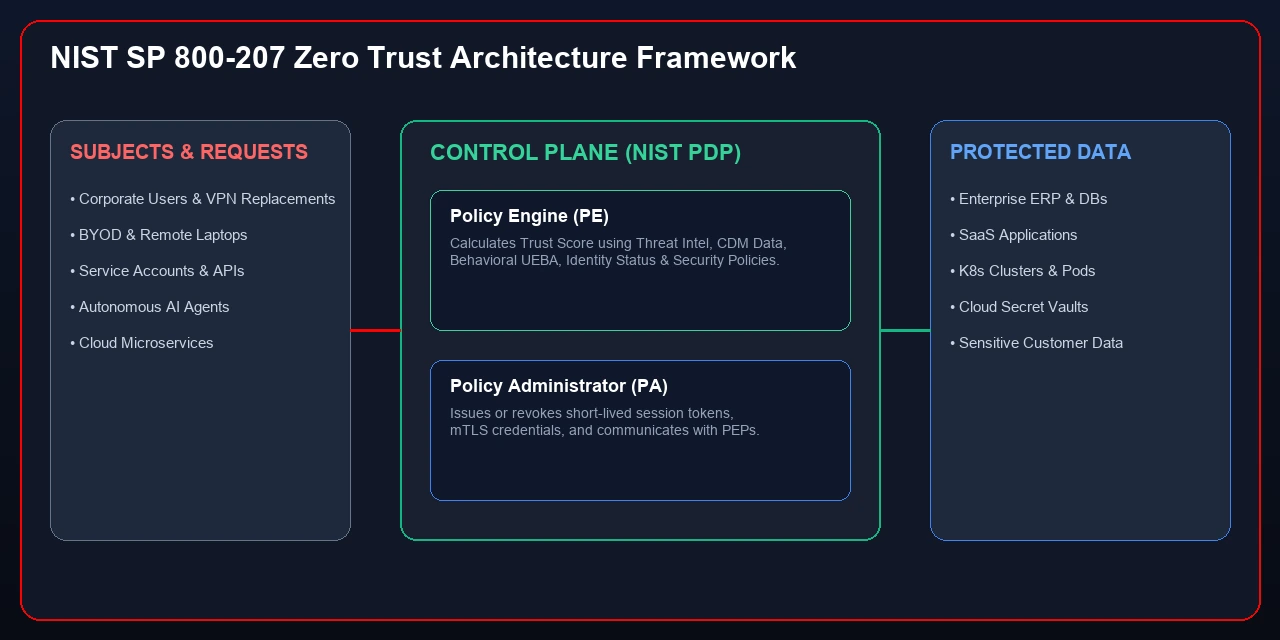
| Policy Engine (PE) | Calculates trust and makes the allow/deny decision (per NIST 800-207) |
| Policy Administrator (PA) | Executes the PE's decision by issuing or revoking session credentials |
| Policy Enforcement Point (PEP) | Gatekeeper that actually permits or blocks the connection |
| Microsegmentation | Restricts east-west traffic between workloads |
| EDR | Detects and responds to threats on endpoints |
| XDR | Correlates detection across endpoint, network, and cloud |
| NDR | Detects anomalies in network traffic patterns |
| Firewall / NGFW | Enforces network-layer policy, application-aware inspection |
| CASB | Governs and monitors SaaS application usage |
| SASE / SSE | Converges networking and security into a cloud-delivered edge |
| SIEM | Aggregates logs for detection and investigation |
| SOAR | Automates response playbooks |
| UEBA | Baselines user/entity behavior to flag anomalies |
| ITDR | Detects identity-specific attacks (Kerberoasting, token theft) |
| PAM | Controls and vaults privileged/admin credentials |
| Device Posture Validation | Confirms endpoint compliance before granting access |
| Certificate-Based Authentication | Uses PKI for strong device/workload identity |
| Secrets Management | Stores and rotates API keys, tokens, and service credentials |
| API Gateway | Enforces authentication and rate limits on API traffic |
| Cloud Workload Protection (CWPP) | Secures VMs, containers, and serverless workloads |
| Identity Governance (IGA) | Manages access reviews, certification, and entitlement audits |
SOC perspective: analysts live inside the SIEM/UEBA/ITDR layer - Zero Trust succeeds or fails on whether these systems get quality signal from the PEPs.
Cloud perspective: CWPP and CASB extend Zero Trust into workloads you don't operate the network for.
DevSecOps perspective: secrets management and API gateways are where Zero Trust actually touches the CI/CD pipeline - hardcoded credentials in a repo defeat the entire model upstream of any policy engine.
6. How Zero Trust Works: The Authentication Flow
Every access request - human or machine - passes through the same conceptual pipeline before it reaches a resource.
flowchart TD
    U[User / Device / Workload] --> ID[Identity Verification]
    ID --> MFA[Multi-Factor Authentication]
    MFA --> DC[Device Posture Check]
    DC --> RE[Risk Engine Scoring]
    RE --> CA[Conditional Access Policy]
    CA --> PD{Policy Decision}
    PD -->|Allow| LP[Least Privilege Session Issued]
    PD -->|Deny| BLK[Access Blocked / Step-Up Auth]
    LP --> APP[Application / Resource]
    APP --> MON[Continuous Monitoring & Re-evaluation]
    MON -->|Risk Change Detected| RE
7. Zero Trust Pipeline Verification Stages
Stage by stage:
- Identity Verification - the IdP confirms the credential is valid and belongs to a known identity.
- MFA - a second factor (push notification, FIDO2 key, TOTP) proves possession or biometric ownership.
- Device Posture Check - is the device managed, encrypted, patched, and free of known compromise indicators?
- Risk Engine - combines signals (IP reputation, impossible travel, anomalous behavior) into a risk score.
- Conditional Access Policy - applies organizational rules: e.g., "block legacy auth," "require compliant device for finance apps."
- Policy Decision - NIST's Policy Engine grants, denies, or requires step-up authentication.
- Least Privilege Session - a scoped, time-limited token is issued, not standing network access.
- Continuous Monitoring - the session is watched for the duration of access; a risk change can trigger re-verification or termination, not just a one-time check at login.
8. Zero Trust Network Access (ZTNA)
ZTNA replaces the VPN's "network-level tunnel" with application-level, identity-aware access. Instead of placing a device on the network, ZTNA brokers a connection to one specific application, after verifying identity and device posture - and the user never sees, or can reach, anything else.
How it differs architecturally
With VPN, a successful login places your device on the corporate network segment. With ZTNA, a broker sits between the user and the application; it verifies the request, then proxies only that one connection. There's no IP-level reachability to anything else - an attacker who compromises the session can't scan or pivot to adjacent systems, because there's no flat network to pivot across.
Real-world deployment pattern
Most enterprises deploy ZTNA in phases: start with remote-access replacement for the highest-risk applications (finance, HR, source code), run it in parallel with the existing VPN, then sunset VPN access application by application as ZTNA policies mature. Full VPN decommissioning is usually a 12-18 month project for a mid-size enterprise, not a weekend cutover.
9. Microsegmentation Explained
Once an attacker is inside the network (assume breach), the goal becomes containment. Microsegmentation divides the network into small, isolated zones - often down to the individual workload - so that a compromised system can't freely talk to its neighbors.
East-west traffic and lateral movement
"North-south" traffic flows in and out of the network; "east-west" traffic flows between internal systems. Traditional firewalls focus almost entirely on north-south. But ransomware spreads east-west, server to server, once it lands. Microsegmentation puts policy enforcement inside the network, not just at the edge.
graph TB
    subgraph "Segment: Finance"
    F1[App Server] --- F2[Database]
    end
    subgraph "Segment: HR"
    H1[App Server] --- H2[Database]
    end
    subgraph "Segment: DevOps"
    D1[CI/CD Runner] --- D2[Artifact Store]
    end
    F1 -.blocked by policy.-> H1
    H1 -.blocked by policy.-> D1
    F1 -.blocked by policy.-> D1
In Kubernetes and cloud workloads
Kubernetes NetworkPolicies and service mesh sidecars (Istio, Linkerd) bring microsegmentation to containers - by default, pods in the same cluster can often talk to each other freely, which is the container equivalent of a flat network. Zero Trust in Kubernetes means explicit allow-lists between services, not implicit cluster-wide reachability.
10. Identity Security
Identity has become the primary attack surface, which is why identity security sits at the center of any real Zero Trust program.
- IAM governs who has access to what, and for how long - role-based and attribute-based models both matter here.
- PAM (Privileged Access Management) vaults and time-limits admin credentials, replacing standing domain admin accounts with just-in-time elevation.
- ITDR (Identity Threat Detection and Response) specifically watches for identity-layer attacks - Kerberoasting, golden ticket attacks, session token theft - that bypass MFA entirely once a token is stolen.
- Passwordless authentication and FIDO2/passkeys remove the phishable credential from the equation altogether, binding authentication to a hardware key or platform authenticator instead of something a user can be tricked into typing on a fake page.
In short: if identity is the new perimeter, then identity security tooling is the new firewall.
11. Zero Trust vs. Traditional Security
| Dimension | Traditional (Perimeter) | Zero Trust |
|---|---|---|
| Trust model | Trusted once inside network | Never trusted by default |
| Verification | One-time, at login | Continuous, per-request |
| Network design | Flat, trusted internal zone | Segmented, least-privilege zones |
| Access scope | Broad network access | Scoped to specific application/resource |
| Remote access | VPN (network-level) | ZTNA (application-level) |
| Breach containment | Poor - lateral movement is easy | Strong - segmentation limits blast radius |
| Primary control point | Network perimeter | Identity + device + context |
12. Zero Trust vs. VPN
Advantages of Zero Trust over VPN:
- No implicit network-level trust after login
- Per-application access instead of full network reachability
- Continuous risk evaluation instead of a one-time check
- Better visibility - every application access is logged individually
- No dependency on network topology; works identically for cloud and on-prem apps
Disadvantages / challenges:
- Requires an identity and device-posture foundation to be in place first
- Legacy applications without modern auth can be harder to broker
- Migration is a multi-phase project, not a swap-in replacement
- User experience change requires training and change management
Hybrid deployment: Most enterprises run ZTNA and VPN side by side during migration - moving high-value applications to ZTNA first, and keeping VPN for legacy systems until they're re-platformed or retired.
13. Zero Trust vs. SASE vs. SSE vs. ZTNA
These terms get conflated constantly. Here's how they actually relate:
| Term | What It Actually Is |
|---|---|
| Zero Trust | The security philosophy - never trust, always verify |
| ZTNA | A specific technology that implements Zero Trust for remote access |
| SSE (Security Service Edge) | A cloud-delivered bundle of security services - ZTNA, CASB, SWG, DLP |
| SASE (Secure Access Service Edge) | SSE plus networking (SD-WAN), converged into one cloud-delivered platform |
Put simply: Zero Trust is the strategy, ZTNA is one tool within it, and SASE/SSE are the delivery platforms that package ZTNA alongside other security services at the network edge.
14. NIST Zero Trust Architecture (SP 800-207)
NIST's model defines three logical components that make every access decision:
graph LR
    Subject[Subject / Device] --> PEP[Policy Enforcement Point]
    PEP <--> PDP[Policy Decision Point]
    PDP --- PE[Policy Engine]
    PDP --- PA[Policy Administrator]
    PE --> Trust[Trust Algorithm + Data Sources: CDM, Threat Intel, Activity Logs]
PEP --> Resource[Protected Resource]- Policy Engine (PE): the "brain" - decides whether to grant, deny, or revoke access based on enterprise policy and a trust algorithm.
- Policy Administrator (PA): generates or revokes the authentication token/session that the PEP will enforce, based on the PE's decision.
- Policy Enforcement Point (PEP): the "gate" that actually sits in the data path - enabling, monitoring, and terminating the connection.
This split matters architecturally because it separates decision from enforcement - the same PE can drive PEPs across VPN alternatives, cloud workloads, and SaaS applications consistently.
15. Zero Trust Maturity Model
CISA's model (aligned closely with NIST) defines four maturity stages across five pillars - Identity, Devices, Networks, Applications & Workloads, and Data:
| Stage | Characteristics |
|---|---|
| Traditional | Static, perimeter-based; manual policy; broad access |
| Initial | Some automation; initial least-privilege attempts; siloed pillars |
| Advanced | Cross-pillar coordination; centralized visibility; dynamic policy |
| Optimal | Fully automated, continuous, context-aware; policies enforced in real time across all pillars |
Most enterprises in 2026 sit somewhere between Initial and Advanced - strong on identity, weaker on data-layer Zero Trust, which tends to mature last.
16. Enterprise Zero Trust Roadmap
| Phase | Focus | Key Actions |
|---|---|---|
| 30 Days | Foundation & visibility | Inventory identities, devices, and apps; enable MFA everywhere; centralize logging |
| 60 Days | Identity hardening | Deploy conditional access; eliminate legacy auth protocols; start PAM for admin accounts |
| 90 Days | First ZTNA rollout | Migrate 2-3 high-value apps off VPN to ZTNA; pilot device posture checks |
| 6 Months | Segmentation | Begin microsegmentation for critical workloads; extend ZTNA coverage; deploy UEBA |
| 12 Months | Full maturity push | Sunset legacy VPN; automate policy with risk-based access; extend Zero Trust to cloud workloads, APIs, and AI agent access |
17. Case Study: Meridian Logistics (Illustrative Enterprise Scenario)
Before Zero Trust: Meridian Logistics, a fictional 4,000-employee freight company, ran a flat internal network with a single perimeter firewall and VPN. Any authenticated VPN user could reach the file servers, the TMS (transport management system), and most of finance.
Attack timeline:
- Day 0: A phishing email harvests a dispatcher's VPN credentials.
- Day 1: Attacker logs in via VPN from an unfamiliar country - no conditional access rule exists to catch it.
- Day 2-4: Attacker moves laterally across the flat network, escalates privileges using a cached local admin password reused across servers.
- Day 5: Ransomware deploys across the file servers and TMS simultaneously. Freight dispatching halts nationwide.
Detection & response: SIEM flags the encryption activity only after volume spikes - far too late for prevention, in time only for containment.
After Zero Trust (rebuilt architecture): Meridian deploys conditional access (blocking impossible-travel logins), replaces VPN with ZTNA for the TMS and finance systems, and microsegments the server VLANs. Six months later, a nearly identical phishing attack succeeds at credential theft - but the login triggers a step-up MFA challenge from an unrecognized device, is denied, and the SOC gets an alert within minutes instead of days.
Lessons learned: Zero Trust didn't stop the phishing email. It stopped the phishing email from becoming a company-wide ransomware event. That distinction - reducing blast radius rather than promising perfect prevention - is the realistic value proposition of Zero Trust.
18. Zero Trust in the Cloud
| Platform | Zero Trust Building Blocks |
|---|---|
| AWS | IAM policies, SCPs, VPC security groups, AWS Verified Access, GuardDuty |
| Azure | Entra ID Conditional Access, Azure Firewall, Microsoft Defender for Cloud |
| Google Cloud | BeyondCorp Enterprise, IAM Conditions, VPC Service Controls |
| Hybrid Cloud | Consistent identity provider across on-prem and cloud; unified policy engine |
| Multi-Cloud | CNAPP/CWPP tooling to normalize posture and policy across providers |
The hardest part of cloud Zero Trust isn't any single platform's tooling - it's maintaining consistent policy when identity, network controls, and logging formats differ across AWS, Azure, and GCP simultaneously.
19. Zero Trust for AI Systems
This is the fastest-moving frontier of Zero Trust, and most enterprise programs haven't caught up yet.
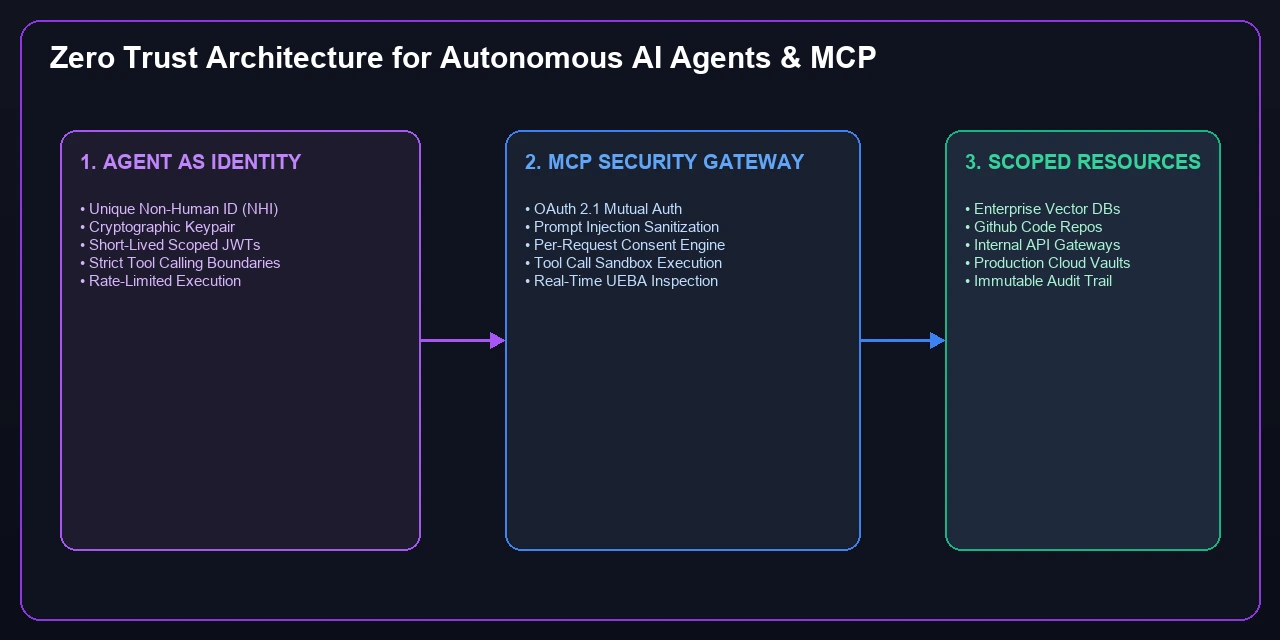
AI agents as identities. An autonomous agent that can call tools, read files, or hit APIs on a schedule is a non-human identity - and it needs the same lifecycle management as a service account: unique identity, scoped permissions, credential rotation, and audit logging. Treating an agent's API key as a "set it and forget it" secret is the modern equivalent of a shared admin password.
MCP security. The Model Context Protocol lets AI agents connect to external tools and data sources. Each MCP server an agent connects to is effectively a new trust boundary - Zero Trust principles apply directly: authenticate the agent to the server, scope what tools it can call, and don't let one compromised MCP connection cascade into access on every other connected tool. Our companion piece on MCP Security Unlocked: The Ultimate 2026 Guide to Defending Model Context Protocol & AI Agents goes deep on this specific attack surface.
LLM and prompt-layer risks. Prompt injection is, structurally, a trust problem - untrusted input (a webpage, a document, a tool response) trying to redirect an authenticated agent's actions. Zero Trust's "never trust input by default" logic extends naturally here: isolate what an agent reads from what it's authorized to do, and require explicit confirmation for high-impact actions. See our deeper breakdown in LLM Security in 2026: OWASP Top 10 for AI Applications, Risk Mitigation & Defense Architecture.
AI supply chain and data protection. Model weights, fine-tuning datasets, and vector stores are assets that deserve the same least-privilege access controls as a production database - not open buckets because "it's just training data."
In short: Zero Trust for AI means giving every agent a real identity, a scoped set of permissions, and continuous monitoring - the same rules you'd apply to a contractor, applied to a non-human actor that can act at machine speed.
20. Zero Trust for Kubernetes & Containers
Kubernetes' default posture is trust-heavy: pods can reach each other across a namespace, and service accounts often have broader RBAC permissions than they need.
- NetworkPolicies define explicit allow-lists between pods - deny-by-default is the Zero Trust baseline, not the Kubernetes default.
- Service mesh (Istio, Linkerd) adds mutual TLS between services, giving every workload a cryptographic identity instead of relying on IP-based trust.
- Docker/container images should run with minimal base images and non-root users - reducing what an attacker inherits even after a successful container compromise.
21. Zero Trust for APIs
APIs are now the primary way applications, services, and AI agents talk to each other - and they're a favorite ransomware and data-exfiltration target because they're often authenticated once and trusted broadly after that.
- OAuth 2.0 provides delegated, scoped authorization instead of sharing raw credentials between systems - see our full breakdown in OAuth 2.0 Unlocked: The Developer's Field Guide to Secure Authorization.
- JWTs carry signed claims about identity and scope, but must be short-lived and properly validated - a JWT with no expiry is a standing credential in disguise.
- API Gateways centralize authentication, rate limiting, and schema validation at the edge, before requests ever reach backend services.
- Rate limiting and threat protection stop credential-stuffing and scraping attempts that would otherwise look like "valid" authenticated traffic.
22. Zero Trust for Remote Work
- BYOD: Enforce device posture checks and conditional access rather than trusting personal devices by default; consider app-level containerization for corporate data.
- Remote employees: ZTNA replaces VPN as the default connection method, scoped per application.
- Contractors and third-party vendors: Time-boxed, least-privilege access - never standing accounts that outlive the engagement.
- SaaS applications: CASB visibility into shadow IT, plus SSO enforcement so SaaS logins flow through the same conditional access policies as internal apps.
23. Zero Trust and Ransomware
Zero Trust doesn't stop the initial phishing email or the first stolen credential - no architecture can guarantee that. What it changes is what happens next.
flowchart LR
    P[Phishing Email] --> C[Credential Theft]
    C --> L1{Flat Network?}
    L1 -->|Yes| LM[Lateral Movement Across Entire Network]
    LM --> ENC[Mass Encryption / Ransomware Deployment]
    L1 -->|No - Zero Trust| SEG[Blocked by Microsegmentation + Conditional Access]
    SEG --> ALERT[Early SOC Alert]
    ALERT --> CONTAIN[Contained to Single Host]
With microsegmentation, conditional access, and least privilege in place, a compromised credential or endpoint is contained to a small blast radius instead of cascading enterprise-wide - turning a potential company-ending event into a single-host incident response ticket.
24. Best Practices
- Start with identity - get MFA and SSO universal before anything else.
- Inventory every identity, human and non-human, before writing policy.
- Adopt deny-by-default network segmentation.
- Replace standing privileged accounts with just-in-time elevation.
- Phase ZTNA rollout by application risk, highest value first.
- Require device compliance for access to sensitive data.
- Log every access decision, not just denials.
- Feed access logs into UEBA for behavioral baselining.
Related Reading
- MCP Security Unlocked: The Ultimate 2026 Guide to Defending Model Context Protocol & AI Agents
- LLM Security in 2026: OWASP Top 10 for AI Applications, Risk Mitigation & Defense Architecture
- OAuth 2.0 Unlocked: The Developer's Field Guide to Secure Authorization
- Agentic AI Explained: How Autonomous AI Systems Will Transform Technology, Software Development, and Business by 2030
- Nmap: Complete Guide to Features, Installation, Use Cases & Best Practices
- Wireshark: Complete Guide to Features, Installation, Packet Analysis & Best Practices
- The Death of GPS: How Hybrid Location Tracking Took Over IoT Logistics
Authoritative sources referenced: NIST SP 800-207, CISA Zero Trust Maturity Model, OWASP, Microsoft Learn, Google Cloud Architecture Center, AWS Security Documentation, Cloudflare Learning Center, Cisco Security Documentation.