Home › AI Tools › Perplexity AI Explained: Features, Models, Pricing, Use Cases, Security, Tutorials & Alternatives (2026 Guide)
AI ToolsPerplexity AI Explained: Features, Models, Pricing, Use Cases, Security, Tutorials & Alternatives (2026 Guide)
By Himanshu Borikar • 2026-07-23 • 13 min read
Last updated: July 2026
Quick Summary: Perplexity AI is an AI-powered search and research assistant - often called an "answer engine" - that combines real-time web retrieval with AI reasoning to deliver direct, cited answers instead of a list of links. It's built on Retrieval-Augmented Generation (RAG), gives users access to multiple frontier AI models, and is widely used by students, researchers, developers, and cybersecurity professionals for fast, source-backed research.
What is Perplexity AI?
Perplexity AI is an AI search engine and AI research assistant built to answer questions directly rather than returning a page of blue links. Instead of making you click through multiple websites, Perplexity retrieves relevant sources in real time, reads them, and generates a synthesized, cited answer.
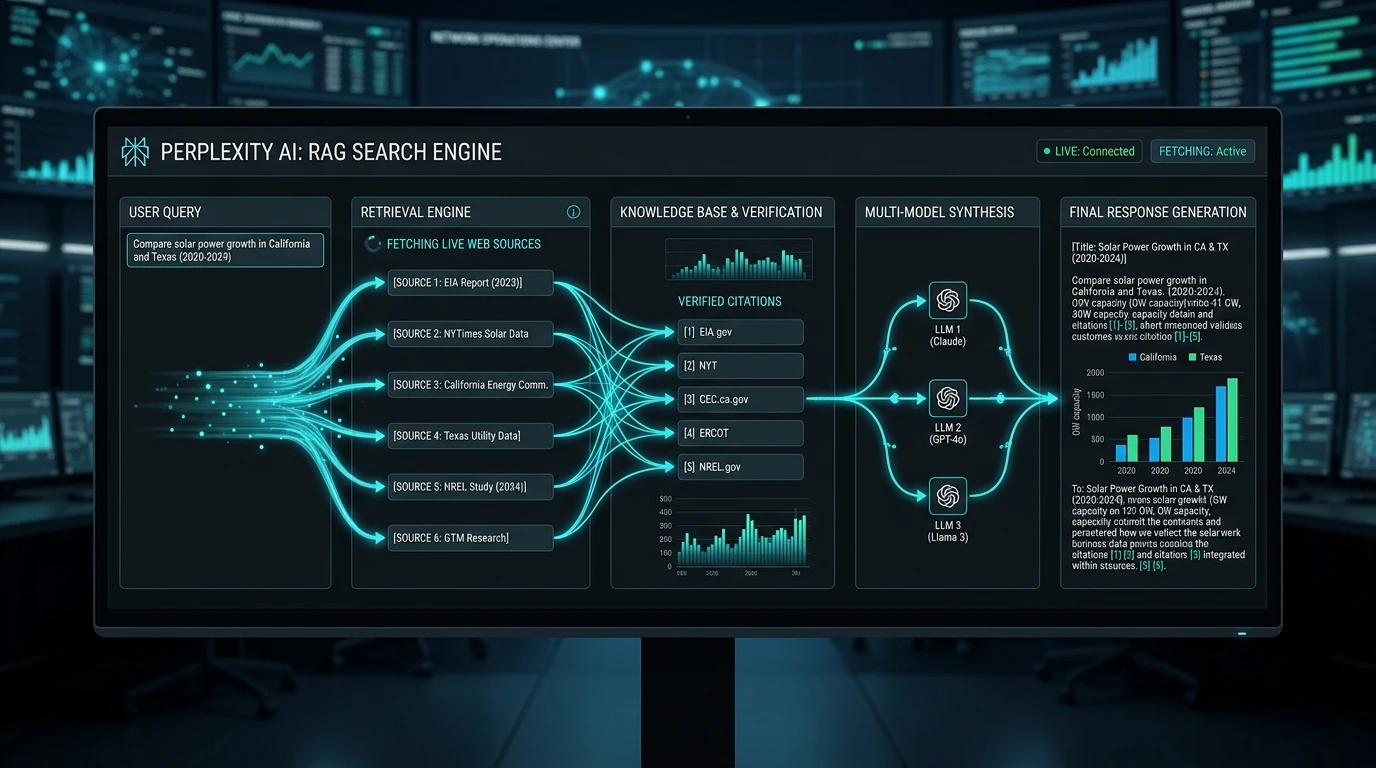
This makes Perplexity fundamentally different from a traditional search engine like Google, which points you toward information, and different from a standard AI chatbot, which often answers from memory alone. Perplexity is powered by Retrieval-Augmented Generation (RAG) - a technique where the AI model pulls in live, verified web sources before generating its response, reducing reliance on outdated training data.
Perplexity became popular because it solves a real frustration: sifting through search results to find a trustworthy answer takes time. As a citation-based answer engine, it shows exactly where each claim comes from, making it easier to verify information - a key reason students, researchers, and knowledge workers increasingly treat it as a serious alternative to traditional search engines.
Official site: perplexity.ai.
How Perplexity AI Works
Perplexity's workflow blends live web retrieval with AI reasoning:
User Question
    |
Web Search Retrieval
    |
Source Collection
    |
AI Analysis & Reasoning
    |
Citation Generation
    |
Answer
When you ask a question, Perplexity searches the web, gathers relevant and recent sources, and has its AI model analyze them before writing a response. Every claim is linked back to a source. This citation step matters - it lets you independently verify facts rather than trusting an AI's output blindly, which is essential for research, journalism, and security work alike.
Perplexity AI Models Explained
Perplexity doesn't rely on a single AI model. Instead, it offers access to several Perplexity AI models, letting users pick the right balance of speed, reasoning, and research depth.
- Auto Mode - Automatically selects a suitable model for your query, balancing speed and quality without manual setup.
- OpenAI Models - Strong general reasoning and broad knowledge coverage.
- Claude Models - Excellent for deep, nuanced research and long-form analysis.
- Gemini Models - Fast responses with solid multimodal support.
| Model Type | Speed | Research | Reasoning | Citations |
|---|---|---|---|---|
| Auto | High | High | High | Yes |
| OpenAI Models | High | High | Very High | Yes |
| Claude Models | High | Very High | Very High | Yes |
| Gemini Models | Very High | High | High | Yes |
[!NOTE] Quick tip
Use Auto for everyday questions, OpenAI models for general reasoning tasks, Claude models for deep or nuanced research, and Gemini models when you want fast turnaround.
Key Perplexity AI Features
AI Search Engine
Conversational search that gives direct, context-aware answers instead of a list of links.
Source Citations
- Every answer includes linked references
- Built-in fact verification against real sources
- Transparent research trail you can check yourself
Deep Research
Multi-step investigations that explore a topic across many sources and compile comprehensive reports - useful for literature reviews or market research.
File Upload Analysis
Upload PDFs, research papers, or documents and ask Perplexity to summarize, extract data, or answer questions about them.
Web Browsing
Access to current information, news analysis, and trend research beyond any model's training cutoff.
Collections & Spaces
Organize related research into folders, save conversations, and collaborate with a team on shared projects.
Follow-Up Questions
Context retention across a conversation lets you refine research step by step, rather than starting over with each new question.
Pricing Overview
As of mid-2026, Perplexity AI pricing spans six tiers, from a genuinely free option to enterprise-scale plans.
| Plan | Approx. Price | Best For |
|---|---|---|
| Free | $0/month | Casual users doing everyday searches |
| Education Pro | ~$10/month (verified students) | Students needing more Pro-level research capacity |
| Pro | ~$20/month (~$200/year) | Researchers and professionals needing unlimited Pro searches and model choice |
| Max | ~$200/month | Power users needing the heaviest research and agentic features |
| Enterprise Pro | ~$40/seat/month | Teams needing Pro features plus admin controls and SSO |
| Enterprise Max | ~$325/seat/month | Organizations running large-scale, research-intensive workflows |
The Free plan offers unlimited basic searches with citations but caps advanced "Pro Search" and Deep Research queries per day. Pro removes those daily limits, unlocks model choice across OpenAI, Claude, and Gemini, and adds file uploads and image generation. Enterprise tiers add centralized billing, seat management, audit logs, and stronger data privacy guarantees for business use.
[!IMPORTANT] Note
Pricing changes fairly often. Always confirm current rates on the official Perplexity pricing page before subscribing.
Perplexity AI for Researchers & Students
As an AI research assistant, Perplexity is widely used for academic research, literature reviews, fact-checking, and study assistance. Instead of manually cross-referencing multiple sources, students and researchers can ask a direct question and receive a cited, synthesized answer they can verify themselves.
Example research prompt:
"Summarize the current scientific consensus on intermittent fasting and metabolic health, citing peer-reviewed sources from the last three years."
Perplexity AI for Developers
Developers use Perplexity for technical research, API documentation lookups, programming tutorials, framework comparisons, technology trend analysis, and discovering relevant open-source projects.
Example developer prompt:
"Compare the current performance and adoption trends of Next.js versus Remix for building server-rendered React applications in 2026."
Perplexity AI for Cybersecurity
As part of a broader set of AI research platform tools, cybersecurity professionals use Perplexity for threat intelligence research, CVE investigation, security news monitoring, vulnerability research, security documentation, and compliance research.
[!WARNING] Disclaimer
Perplexity AI can accelerate security research, but all findings should be independently verified before making security decisions.
Security & Privacy Considerations
Research Data Privacy
Be mindful of what you upload - sensitive documents or proprietary information deserve extra caution before being shared with any AI research tool.
AI Risks
- Hallucinations, even when citations are present
- Source quality issues if underlying web content is inaccurate or biased
- Outdated information if sources aren't recent
Best Practices
- Verify citations by checking the original source, not just the AI summary
- Cross-check critical information across multiple sources
- Protect confidential or proprietary data from being entered into prompts
- Validate research findings before using them in decisions
Security Research Perspective
Perplexity AI can meaningfully support cybersecurity investigations by speeding up the early research phase - pulling together CVE details, vendor advisories, and recent threat reporting into one cited summary instead of dozens of manual searches.
For threat intelligence teams, this means faster initial triage: quickly understanding a new vulnerability, checking whether it's being actively exploited, or getting up to speed on an unfamiliar threat actor. Typical security research workflows include using Perplexity to scan recent security news, gather background on a CVE, or summarize a vendor's incident disclosure before deeper manual analysis begins.
The risk is treating AI-generated research as a final answer rather than a starting point. Security decisions based on unverified AI summaries can be dangerous if a source was outdated, misread, or simply wrong.
Recommended verification process for security professionals:
- Use Perplexity for initial research and source discovery, not final conclusions
- Open and read the original cited sources for anything decision-critical
- Cross-reference findings with primary sources like vendor advisories or the National Vulnerability Database
- Have a second analyst review high-stakes findings before acting on them
Perplexity AI Tutorial
- Step 1 - Create an account: Sign up for free at perplexity.ai to get started.
- Step 2 - Choose a research topic: Start with a clear, specific question rather than a vague one.
- Step 3 - Use focused search queries: Narrow queries produce more relevant, higher-quality sources than broad ones.
- Step 4 - Review citations: Click through to check that sources are credible and current.
- Step 5 - Ask follow-up questions: Use the conversational context to refine or dig deeper into your topic.
- Step 6 - Export or organize research: Save findings into Collections or Spaces to keep research organized for later use.
Perplexity AI Alternatives
Several strong Perplexity AI alternatives exist, each with different strengths.
| Tool | Best For |
|---|---|
| Perplexity AI | Research & citations |
| ChatGPT | General AI assistance |
| Claude AI | Long-form analysis |
| Gemini AI | Google ecosystem |
| Copilot | Microsoft ecosystem |
| Google Search | Traditional search |
Choose Perplexity over alternatives when source transparency and citation-backed answers matter most - such as academic research, fact-checking, or security investigations - rather than general-purpose conversation or content generation.
Pros and Cons
Pros
- Strong source transparency with linked citations
- Real-time information beyond any model's training cutoff
- Access to multiple frontier AI models in one place
- Genuinely useful free tier
Cons
- Daily limits on advanced searches for free and lower-tier users
- Research quality depends on the quality of underlying web sources
- Higher-tier plans (Max, Enterprise Max) are costly for casual use
Key Takeaways
- Perplexity AI is an answer engine, not just a chatbot - it retrieves and cites live sources
- It's built on Retrieval-Augmented Generation (RAG), reducing reliance on outdated training data
- Pricing ranges from a free tier to $325/seat/month for Enterprise Max
- Best suited for research, fact-checking, and citation-backed work over general conversation
- Always verify AI-generated research against original sources before high-stakes decisions
Frequently Asked Questions
Is Perplexity AI free?
Yes, the Free plan is genuinely usable with unlimited basic searches, though advanced "Pro Search" and Deep Research queries are capped daily.
Is Perplexity AI better than Google Search?
For direct, cited answers to specific questions, many users find Perplexity faster; for broad browsing or shopping, traditional search still has advantages.
Can Perplexity AI replace ChatGPT?
Not entirely - Perplexity excels at citation-based research, while ChatGPT is often preferred for general conversation, writing, and coding assistance.
How accurate is Perplexity AI?
Accuracy is generally strong thanks to source citations, but it still depends on source quality, so critical facts should be verified.
Is Perplexity AI useful for cybersecurity research?
Yes, for accelerating threat intelligence and vulnerability research - but findings should always be independently verified before security decisions.
Conclusion
Perplexity AI has become one of the best AI research assistants available by combining real-time web search, multiple frontier models, and transparent citations in a single answer engine. Its strengths in source verification and fact-based answers make it especially valuable for students, researchers, developers, and cybersecurity professionals who need to trust what they read. As generative AI search continues to reshape how people find information, Perplexity is well positioned to remain a leading choice. If reliable, citation-backed research matters to you, it's well worth trying at perplexity.ai.
Related Technical Reviews & AI Tools
- 💻 Cursor AI Explained: Features, Models, Pricing & Alternatives - Anysphere Cursor AI code editor, whole-codebase indexing, and multi-file editing.
- 🤖 ChatGPT Explained: Features, Models, Pricing & Alternatives - Complete breakdown of OpenAI ChatGPT, GPT-4o & GPT-5 series.
- 🧡 Claude AI Explained: Features, Models, Pricing & Alternatives - Anthropic Claude AI, 200k+ token context window, and model comparison.
- ✨ Google Gemini AI Explained: Features, Models, Pricing & Alternatives - Google DeepMind Gemini AI, multimodal architecture, and Workspace integration.
- 🛡️ Zero Trust Architecture Explained - Complete enterprise security roadmap, NIST SP 800-207 model, and ZTNA.